

Key Takeaways
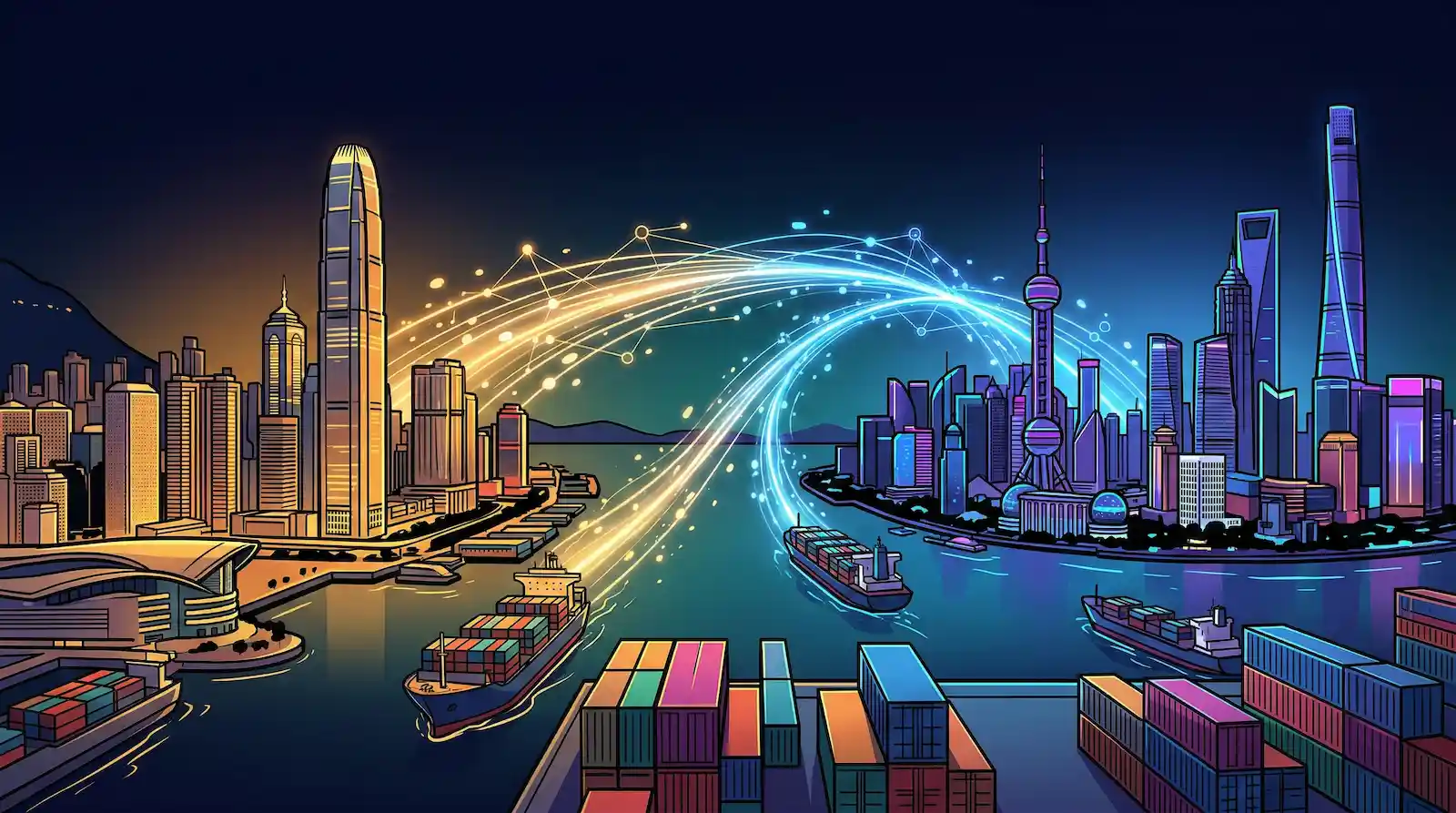
- HKMA, Shanghai Data Bureau, and China’s National Blockchain Centre agreed to jointly develop cross-border digital cargo trade infrastructure.
- The deal connects HKMA’s existing CDI data network and Project Ensemble tokenization framework to Shanghai’s trade corridor.
- HKMA’s CDI has already facilitated over 82,000 loan applications worth HK$66.4 billion since its October 2022 launch.
March 2 (Crypto-News.Net) – The Hong Kong Monetary Authority (HKMA) signed a memorandum of understanding with the Shanghai Data Bureau and China’s National Technology Innovation Centre for Blockchain. The three parties agreed to build a digital trade finance platform for cross-border cargo data.
HKMA Deputy Chief Executive Howard Lee, Shanghai Data Bureau Director Dr. Shao Jun, and National Blockchain Centre Director Dong Jin signed the MOU. Specifically, it covers joint research on digital technology, development of a cross-border platform, and exploration of electronic bills of lading under Project Ensemble, according to the HKMA’s official announcement.
Three-Way Agreement
Lee called the agreement “an important milestone in the collaboration on financial innovation between Shanghai and Hong Kong” and said it would strengthen digitized cargo trade cooperation between the two cities.
The HKMA described Hong Kong as a “super connector” bridging mainland China and international markets. Trade is the city’s second-largest industry, contributing 15% of GDP. In 2024, trade volume reached 3.6 times the city’s annual GDP, according to the South China Morning Post.
HKMA Digital Trade Finance Programs
In particular, the MOU builds on two HKMA digital trade finance programs already in operation.
The Commercial Data Interchange (CDI) is a consent-based data-sharing network launched in October 2022. Since then, it has facilitated more than 82,000 loan applications worth HK$66.4 billion (US$9.5 billion) as of December 2025. CDI loans carry interest rates 36 basis points lower on average, across 26 banks and 17 data providers, the SCMP reported.
Project CargoX, established in April 2025, uses CDI infrastructure to modernize trade finance. Lenders can approve loans based on cargo and business data rather than property collateral. An expert panel released a 20-point recommendation report in December 2025. The first measures are set to roll out over the next three years. Howard Lee has said many small businesses “have never borrowed trade finance as they lack property or other assets for collateral.”
Tokenization and CBDC Connection
The agreement also references Project Ensemble, HKMA’s wholesale central bank digital currency project announced in March 2024. The Ensemble Sandbox launched in August 2024 to test tokenization across four themes, including trade and supply chain finance.
In November 2025, HKMA launched EnsembleTX, a pilot for real-value tokenized deposit transactions. Seven banks participate, including Standard Chartered, HSBC, and Bank of China (Hong Kong). Asset managers BlackRock and Franklin Templeton also joined. The pilot settles through Hong Kong’s Real Time Gross Settlement system and runs through 2026, according to HKMA’s EnsembleTX announcement.
In addition, the MOU’s eBL exploration under Project Ensemble would bring electronic trade documents into this tokenization framework. As of 2022, only about 2.1% of bills of lading were digital. Nine major carriers in the Digital Container Shipping Association have committed to 100% electronic issuance by 2030. Ten jurisdictions have adopted UNCITRAL’s Model Law on Electronic Transferable Records, including the UK, Singapore, and France.
Trade Corridor and Digital Trade Finance Outlook
The agreement comes as trade volumes between mainland China and global markets continue to grow. China’s ports handled 350 million twenty-foot equivalent container units in 2025. Shanghai processed 55.06 million TEUs for the full year, making it the world’s busiest port, according to the SCMP. China recorded a $1.19 trillion trade surplus for 2025.
The MOU is the first major cross-border implementation step under HKMA’s Fintech 2030 strategy, announced in November 2025. That strategy organizes Hong Kong’s financial technology agenda around four pillars known as DART: Data, AI, Resilience, and Tokenization.
However, previous attempts to digitize global trade on shared platforms have faced difficulties. TradeLens, a blockchain shipping platform built by IBM and Maersk, had over 300 industry members and data from more than 600 ports. It shut down in November 2022 after failing to achieve commercial viability, according to Maersk’s announcement. That platform was run by a private company. In contrast, HKMA’s initiative is government-led.
Reporting by Zoran Spirkovski.
