

Last Updated: Dec. 14, 2025
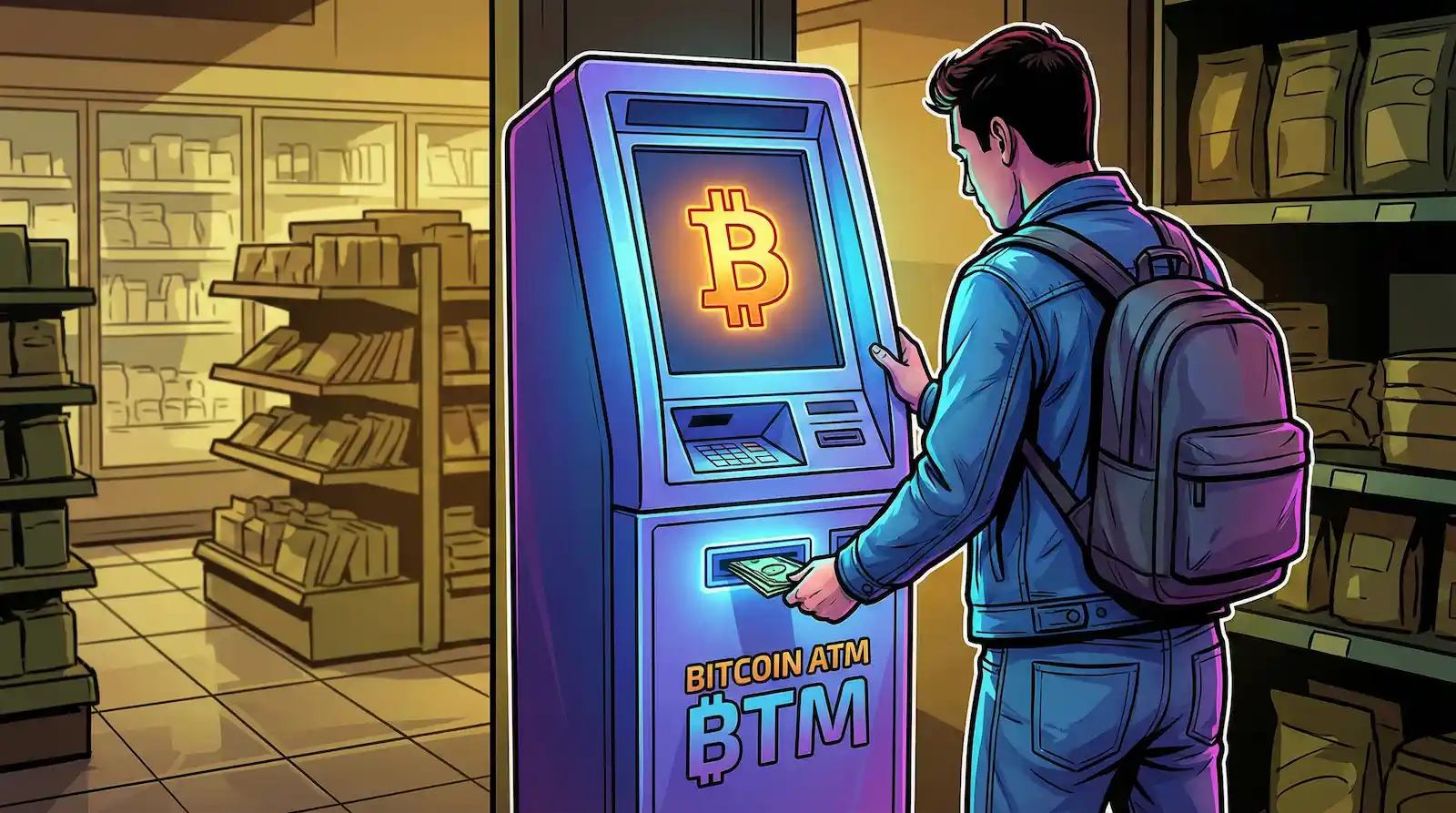
A Bitcoin ATM (sometimes called a BTM) is a physical kiosk that allows you to buy or sell Bitcoin using cash or a debit card. Unlike traditional ATMs connected to your bank account, these machines connect directly to cryptocurrency exchanges, enabling you to convert physical currency into digital assets on the spot.
As of December 2025, over 39,000 Bitcoin ATMs operate worldwide, with the United States hosting roughly 32,000 of them, according to CoinATMRadar. The number of machines has grown rapidly since 2020, rising from approximately 4,250 in January 2020 to over 30,000 by mid-2024. This growth means Bitcoin ATMs are now accessible in most urban areas across the US.
Disclaimer: This article is for informational purposes only and does not constitute financial, investment, or trading advice. Cryptocurrency investments carry significant risk. Always conduct your own research and consult a qualified financial advisor before making investment decisions.
How Bitcoin ATMs Work
Bitcoin ATMs function differently depending on whether you’re buying or selling cryptocurrency.
Buying Bitcoin
The purchasing process typically follows these steps:
- Select “Buy Bitcoin” on the machine’s screen
- Enter the amount you wish to purchase (in dollars)
- Provide identity verification (requirements vary by machine and amount)
- Scan your Bitcoin wallet’s QR code or receive a paper wallet
- Insert cash into the machine
- Confirm the transaction and receive your Bitcoin
Most machines process transactions within minutes, though blockchain confirmation times (the network verification process that finalizes your transaction) can vary.
Selling Bitcoin
Not all Bitcoin ATMs support selling, but those that do generally work like this:
- Select “Sell Bitcoin” on the screen
- Complete identity verification
- Send Bitcoin to the address displayed on screen
- Wait for blockchain confirmations (this can take 10 to 60 minutes)
- Collect your cash from the machine
Verification Requirements
Bitcoin ATMs implement Know Your Customer (KYC) requirements that vary based on transaction size. Small transactions (often under $250 to $500) may only require a phone number. Larger transactions typically require government ID, and some machines use facial recognition or fingerprint scanning for high-value purchases.
Bitcoin ATM Fees
Bitcoin ATM fees are much higher than those charged by online exchanges. According to Wikipedia’s compilation of industry data, typical fees range from 6.5% to 20%, with most machines charging between 8% and 15%.
For example, purchasing $500 worth of Bitcoin at a machine charging 12% would cost you $60 in fees, meaning you’d receive approximately $440 worth of Bitcoin.
Why Fees Are Higher Than Exchanges
Several factors contribute to the elevated costs:
- Physical machine maintenance and real estate expenses
- Cash handling and armored transport services
- Regulatory compliance costs
- Lower transaction volumes compared to online platforms
- Convenience premium for immediate, cash-based transactions
For comparison, major online exchanges typically charge between 0.1% and 0.6% for trading fees (Kraken charges 0.16% to 0.26%; Coinbase charges 0.40% to 0.60%), though total costs including payment method fees can be higher, according to LearnCrypto’s exchange fee comparison. If minimizing fees is your priority, online exchanges offer more cost-effective options.
Where to Find Bitcoin ATMs
The easiest way to locate a Bitcoin ATM is through CoinATMRadar, a comprehensive directory that maps machines globally. The site allows you to filter by operator, supported cryptocurrencies, and whether machines support both buying and selling.
Major Operators
Several companies operate large networks of Bitcoin ATMs. According to CoinLaw’s industry statistics, the market leaders include:
- Bitcoin Depot leads with over 8,400 machines (21.8% market share)
- CoinFlip operates 5,289 machines (13.6% market share)
- Athena Bitcoin maintains 3,797 machines (9.8% market share)
- RockItCoin runs 2,562 machines (6.6% market share)
- Coinhub operates 1,823 machines (4.7% market share)
Geographic Distribution
Bitcoin ATMs concentrate heavily in North America, with the United States accounting for over 81% of all machines worldwide, according to Finbold research citing CoinATMRadar data. Urban areas typically have higher density, though machines increasingly appear in suburban convenience stores and shopping centers.
Pros and Cons of Bitcoin ATMs
| Pros | Cons |
|---|---|
| Cash transactions without bank involvement | High fees (8% to 15% or more) |
| No bank account required | Limited locations compared to online access |
| Immediate transactions | Lower purchase limits than exchanges |
| Physical, familiar interface | Significant scam risk (see Safety Tips) |
| Some privacy for small transactions | Not all machines support selling |
Who Uses Bitcoin ATMs?
Bitcoin ATMs serve several distinct user groups:
Unbanked and Underbanked Individuals
People without traditional bank accounts can use Bitcoin ATMs to access cryptocurrency using cash. In areas without nearby banks, these machines provide the only physical access point to cryptocurrency.
Privacy-Conscious Users
For smaller transactions below KYC thresholds, Bitcoin ATMs offer more privacy than bank-linked exchange accounts. However, most machines still collect phone numbers or IDs for compliance purposes.
Convenience Seekers
Some users prefer the immediacy of walking into a location and completing a transaction rather than navigating exchange account setup, bank transfers, and verification processes.
First-Time Buyers
The familiar ATM interface helps first-time buyers avoid the complexity of exchange account setup, verification delays, and learning new platforms.
Safety Tips
Critical Warning: Bitcoin ATM Scams Are Rising Rapidly
The Federal Trade Commission reports that Bitcoin ATM fraud increased nearly tenfold between 2020 and 2023. In the first half of 2024 alone, consumers reported losing over $65 million to Bitcoin ATM scams, according to FTC data.
Key statistics from the FTC:
- The median loss per victim is $10,000
- People aged 60 and older are three times more likely to be targeted
- Adults over 60 account for 71% of total BTM fraud losses
- 86% of scams involve government or business impersonation
Common Scam Patterns
Scammers typically contact victims claiming to be from government agencies (IRS, Social Security), tech companies, or utilities. They create urgency by claiming your accounts are compromised, you owe back taxes, or you’ve won a prize requiring fee payment. They then direct victims to a Bitcoin ATM to “protect” their money or pay a “fine.”
How to Protect Yourself
- No legitimate government agency, utility, or business will ever ask you to pay via Bitcoin ATM
- If someone you’ve never met in person asks you to use a Bitcoin ATM, it’s almost certainly a scam
- Legitimate businesses and agencies accept standard payment methods
- Never scan a QR code provided by someone claiming to be from a company or government
- Verify any claims independently by calling official numbers from company websites (not numbers provided by the caller)
- Keep your receipt and report suspicious activity to the FTC at ReportFraud.ftc.gov
General Safety Practices
- Use machines in well-lit, public locations during business hours
- Verify the machine belongs to a reputable operator before transacting
- Double-check all wallet addresses before confirming
- Keep your transaction receipt until Bitcoin arrives in your wallet
- Be aware of your surroundings when handling cash
Conclusion
Bitcoin ATMs provide a physical, cash-based entry point into cryptocurrency that can serve users who prefer not to use (or don’t have access to) traditional banking and online exchanges. However, the convenience comes at a cost: fees typically run 8% to 15% or higher.
For most users, online exchanges offer lower fees and broader functionality. Bitcoin ATMs make the most sense for those who specifically need cash-based transactions, lack bank accounts, or strongly prefer the immediacy and physical nature of ATM-style purchases.
Given the rapid rise in Bitcoin ATM scams, anyone using these machines should exercise extreme caution. Remember: no legitimate organization will ever direct you to pay them through a Bitcoin ATM.
Sources
- CoinATMRadar. (2025). Bitcoin ATM Industry Statistics. https://coinatmradar.com/
- CoinLaw. (2025). Crypto ATM Statistics 2025. https://coinlaw.io/crypto-atm-statistics/
- Federal Trade Commission. (2024, September). Bitcoin ATMs: A Payment Portal for Scammers. https://www.ftc.gov/news-events/data-visualizations/data-spotlight/2024/09/bitcoin-atms-payment-portal-scammers
- Finbold. (2025). Over 2,000 new Bitcoin ATMs installed globally in 2024. https://finbold.com/over-2000-new-bitcoin-atms-installed-globally-in-2024/
- LearnCrypto. (2024). Crypto Exchange Fees 2024. https://learncrypto.com/feed/articles/crypto-exchange-fees-2024-binance-coinbase-bybit-bitstamp-cryptocom-okex-kraken-kucoin-gateio-htx
- Wikipedia. (2025). Bitcoin ATM. https://en.wikipedia.org/wiki/Bitcoin_ATM
