
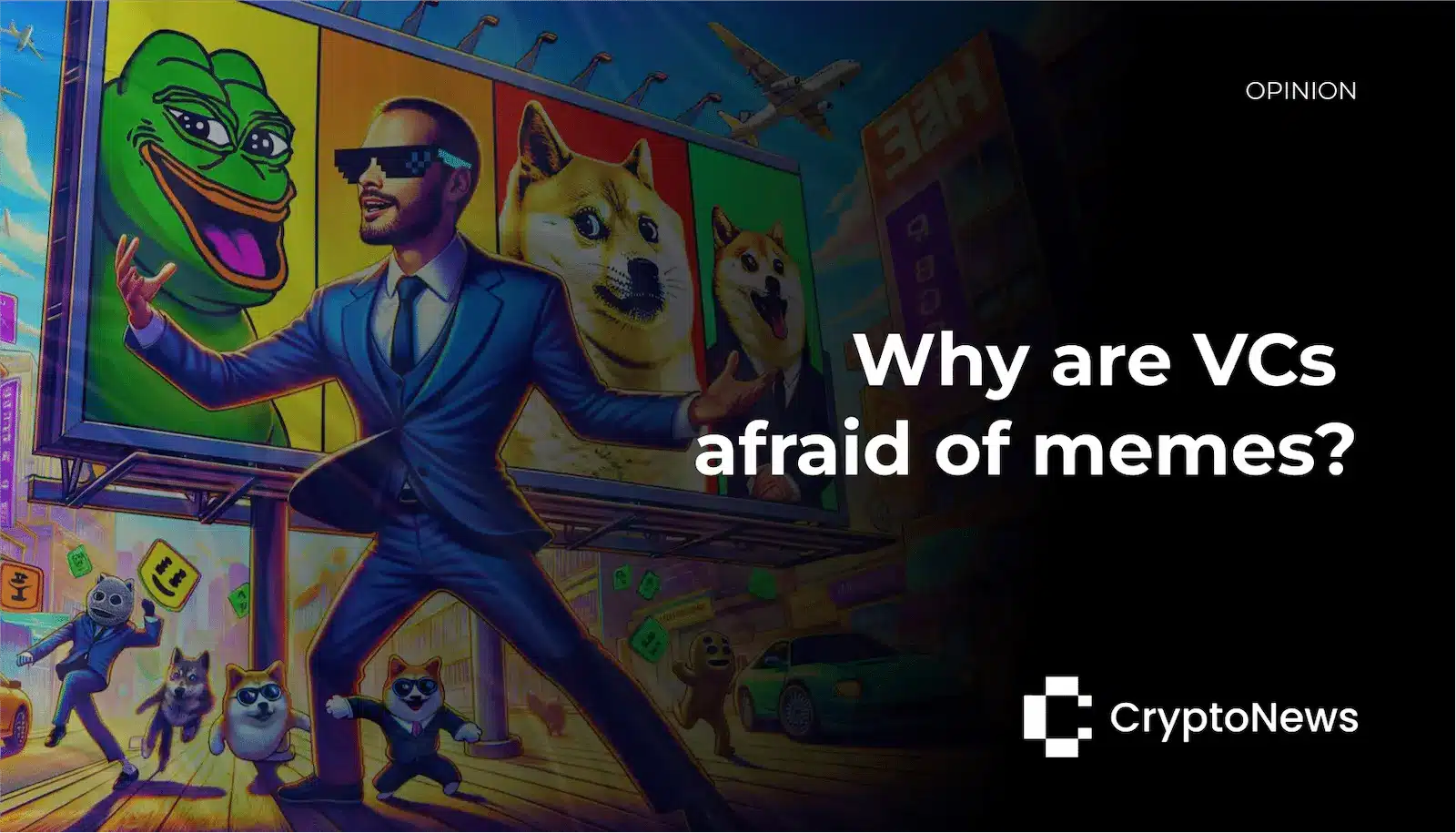

Despite viral success stories like WIF and DOGE, venture capitalists remain hesitant to deploy capital into assets lacking fundamental revenue models.
Key Takeaways:
- Institutional Hesitancy: Major funds like KuCoin Ventures avoid direct meme coin investment, preferring infrastructure plays or secondary market liquid funds.
- Structural Mismatch: The “fair launch” nature of meme tokens denies VCs the early-stage entry points required by their traditional investment mandates.
- The Speed Factor: Solana’s high-speed infrastructure has accelerated meme coin lifecycles, increasing the volatility risks for institutional-grade portfolios.
Venture capitalists (VCs) generally view meme coin investment with skepticism, viewing the sector’s community-driven valuations as incompatible with traditional investment theses. While some assets have established permanent niches through viral momentum, the asset class remains a high-stakes gamble for institutional funds.
Established tokens like Dogecoin and Shiba Inu demonstrate the volatility that deters stable capital. Dogecoin, with a market capitalization of $22.14 billion in May 2024, recently recorded a 23.08% decline. These fluctuations illustrate the liquidity risks inherent to the sector.
Newer entrants such as dogwifhat recently reached a market cap of $3.23 billion, posting a 25.49% gain even as the broader market cooled. These rapid valuation shifts define the market and contribute to VC hesitancy.
Crypto-News.Net contacted multiple venture capital firms to verify institutional positions on the sector.
Institutional Stance on Meme Coin Investment
A KuCoin Ventures representative clarified their firm’s approach, noting their stance has remained neutral over the past five years.
“We appreciate the enthusiasm and hype that meme coins generate among users and within the industry. However, as a responsible exchange, we also want our users to be aware of the investment risks involved. KuCoin Ventures does not directly invest in meme projects,” the representative said.
While direct investment is rare, the industry is exploring other exposure methods. The representative added that they are exploring new business models, such as funds establishing liquid funds that allow participation in valuable meme coins through secondary market investments.
The reluctance stems less from total avoidance and more from structural incompatibility. Meme coins are typically “born” on the open market rather than incubated. This denies VCs the early-stage entry points they utilize in infrastructure or Decentralized Finance (DeFi) investments. Furthermore, the extreme volatility is difficult to justify to limited partners, the external investors who provide capital to VC funds.
The Liquidity Trap and Valuation Models
For institutional investors, the primary barrier is often liquidity depth rather than potential returns. Learning how to invest in crypto safely usually involves analyzing fundamental revenue, but meme coins lack these metrics.
While “Fear of Missing Out” (FOMO) drives retail volume, VCs remain wary of “exit liquidity”, the risk of being unable to sell large positions without crashing the price. This is particularly relevant in yield farming or liquidity mining scenarios where meme coins are paired with more stable assets in smart contracts.
Tokens like Pepe and Popcat have delivered strong short-term performance, with Popcat jumping 76.75% recently. However, the potential for abrupt downturns pushes institutional money toward projects with predictable revenue models. Consequently, funds often miss the initial explosive growth phases of viral tokens to prioritize capital preservation.
The Community Factor
DuckDAO, a community-led venture group, pointed to the tension between community power and investment logic.
“We know the power of communities first-hand, but even with that being said, the spontaneity of meme coins and their unlikely survival makes them a difficult investment decision,” a DuckDAO member stated. “We love taking risks, but meme coins are next level, the chance of failure is simply too great to risk making a large investment.”
Infrastructure Accelerates Volatility
The Solana blockchain has emerged as the primary infrastructure for recent meme coin activity. Low transaction costs and high processing speeds have attracted speculative volume away from Ethereum.
This shift underscores the ongoing Ethereum vs Solana battle for dominance. While Ethereum provides stability, Solana’s technological architecture allows for faster capital rotation and community formation, accelerating the lifecycle of meme projects.
Valuations for assets like Dogecoin and WIF rely almost exclusively on social sentiment and popular culture rather than revenue or utility. This dynamic challenges standard VC valuation models, which depend on fundamental metrics. In this sector, public perception dictates value independently of technical merit.
The sector continues to test the boundaries of traditional investment strategies. While the returns can be significant, the lack of structural fundamentals makes meme coins a difficult asset class for venture capital firms to incorporate into standard portfolios.
