


A stablecoin depeg is when a token’s market price moves significantly away from the value it is meant to track. There is no universal percentage or minimum duration that defines every depeg. The European Central Bank describes depegging as the loss of intended price stability, while the Financial Stability Board says the term “stablecoin” does not guarantee stability.
Research and policy sources distinguish market price from reserve quality, redemption access and confidence. A price break is a signal to investigate. By itself, it does not prove why the peg moved or whether it will recover.
What does a stablecoin depeg mean?
A stablecoin is designed to track a reference value, commonly a national currency such as the U.S. dollar. The reference value and the market price are related but separate. A token can trade on crypto exchanges while direct issuance or redemption takes place through an issuer or protocol under different rules.
That distinction matters during stress. BIS and New York Fed researchers note that direct issuer redemption is generally restricted to selected participants in the arrangements they studied. Many holders instead buy and sell in secondary markets. A market price can therefore move away from the target while participants are still trying to determine who can redeem, whether backing assets are available and whether the stabilizing mechanism continues to function.

Depeg, run and collapse are not the same thing
| Term | Meaning in this article | What it does not prove |
|---|---|---|
| Depeg | The market price moves significantly away from the target value | The cause, reserve position or permanence of the move |
| Run | Selling or redemptions accelerate as holders seek to exit | That collapse is inevitable |
| Collapse | A severe or persistent breakdown of the stabilizing structure | That every temporary price move is permanent |
A depeg describes a price condition. A run describes accelerating exit behavior. The two can occur together, and a run can deepen a depeg, but they are not identical.
The New York Fed documented episodes in which investors moved from stablecoins they perceived as riskier toward alternatives they perceived as safer. That was a study result, not a current safety ranking.
What happens in the market during a depeg?
The sequence differs by event, but several questions usually become important at once.
For eligible participants, continued direct redemption or protocol conversion can support arbitrage toward the target. New York Fed research also documents the opposite path: when confidence falls, selling or redemptions can accelerate, and some investors may shift toward tokens they perceive as less exposed to the source of stress.
Pressure can also spread through shared dependencies. BIS and New York Fed research documented spillovers to stablecoins that shared collateral during the March 2023 USDC episode. New York Fed researchers also note that stablecoins can be used as collateral in decentralized-finance protocols, creating connections across blockchain applications. Those connections can create spillovers, but they do not make them automatic.
Holders may face a changing secondary-market value while lacking direct access to the issuer. Many depend on secondary-market trading, while issuers, custodians and authorized participants deal with redemption, reserve or banking channels. An action by an issuer, custodian, protocol or government can change the conditions around a depeg, but no such action guarantees recovery.
Why do stablecoins depeg?
A depeg does not have one universal cause. Different designs can fail under different conditions, and more than one source of pressure can be present at the same time.
Market selling and redemption pressure
In the New York Fed’s historical sample, redemptions accelerated after stablecoin prices moved below $1. That was a sample-specific finding, not a universal threshold for every token or event.
Researchers compare some stablecoin arrangements with money market funds because both can support instruments intended to hold a stable value with assets that may become hard to sell during stress. The analogy has limits, but it helps explain why redemption demand and asset liquidity must be assessed together.
Reserve, collateral or counterparty stress
Backing assets can lose value, be hard to sell quickly or become inaccessible through a bank, custodian or other counterparty. BIS research distinguishes liquidity from solvency: the immediate question can be whether enough cash is available to meet redemptions, not only whether asset value exceeds liabilities.
More reserve disclosure is not always stabilizing. BIS working-paper authors found that more information could increase or reduce run risk depending on prior confidence and perceived reserve quality. An issuer statement can explain what the issuer says happened, but it does not independently establish reserve adequacy or causation.
Redemption or operational bottlenecks
A peg can come under pressure when conversion or settlement is delayed, restricted or unavailable to many holders. New York Fed researchers describe financial-asset-backed arrangements in which eligible customers mint tokens by depositing dollars and redeem by returning tokens to the issuer. The same research says primary-market access can be restricted.
This means a stated redemption price should not be treated as a universal transaction available to every holder. Eligibility, banking rails and issuer-specific terms require product-level evidence.
Crypto-collateral liquidation
New York Fed researchers describe some crypto-backed stablecoins as backed by volatile cryptoassets and typically overcollateralized. Designs differ, and there is no universal collateral ratio or liquidation procedure.
DAI provides one documented example. The New York Fed explains that if collateral falls below the required level, any user can call a contract function that liquidates it through an auction. That mechanism should not be generalized to every crypto-backed stablecoin.
Algorithmic or hybrid mechanism failure
New York Fed researchers describe algorithmic pegs that depend on traders continuing to use an arbitrage mechanism. If a stablecoin trades below its target, the mechanism may offer conversion into another asset. That process supports the peg only while participants trust the paired asset and can complete the trade.
Hybrid arrangements also exist. The New York Fed staff report gives Frax as a historical example that combined outside collateral with an algorithmic mechanism. This establishes that the categories can overlap. It does not establish Frax’s current design without current product documentation.
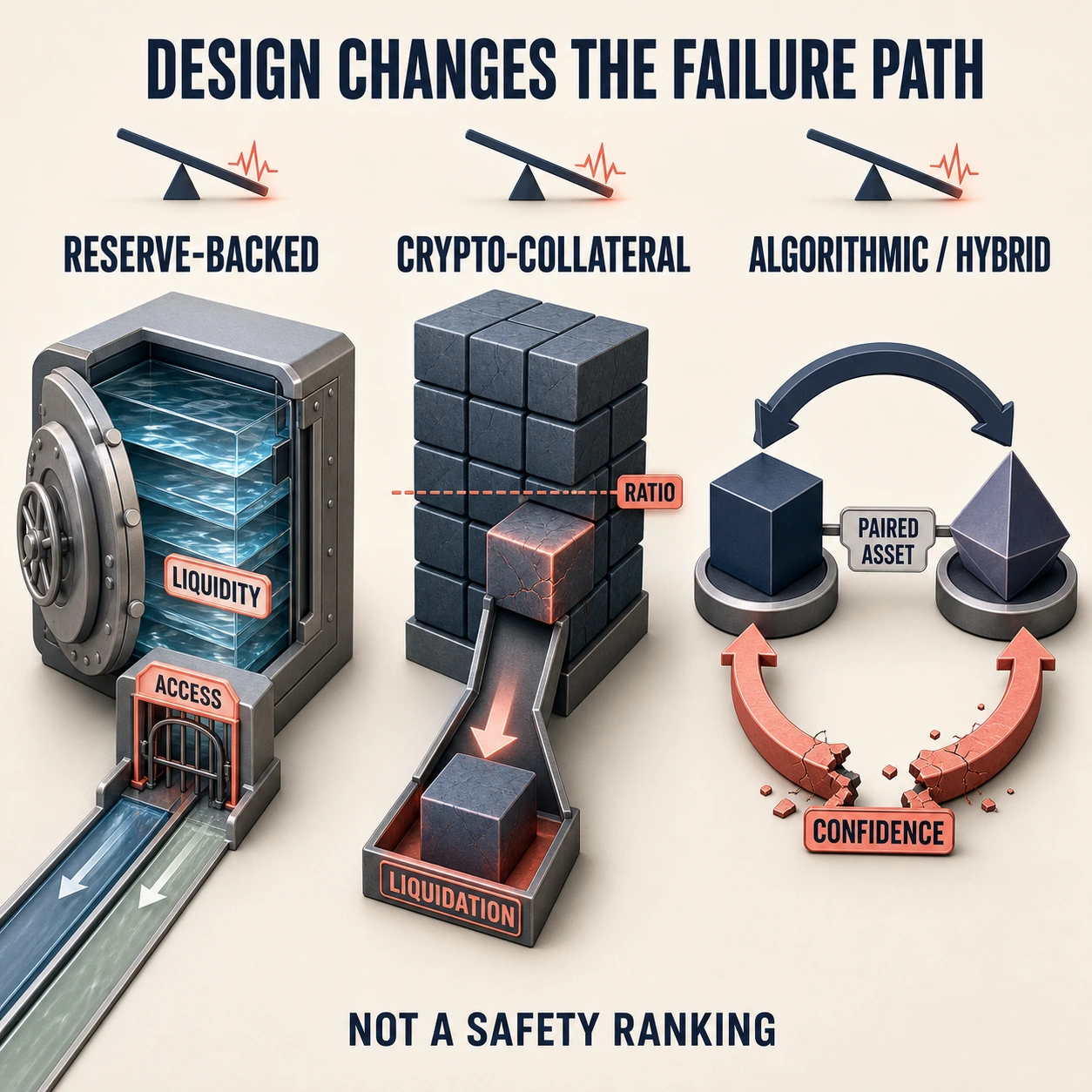
How a stablecoin’s design changes the failure path
| Practical model | Intended stabilizer | Evidence to inspect during stress |
|---|---|---|
| Fiat or reserve-backed | Reserves plus issuance and redemption | Reserve composition, custody, liquidity and actual redemption terms |
| Crypto-collateralized | On-chain collateral and contract rules | Collateral type, required ratios and documented liquidation rules |
| Algorithmic or hybrid | Arbitrage, supply changes, paired assets and possibly partial collateral | Whether conversion still functions, paired-asset liquidity and confidence assumptions |
These are practical models, not exhaustive legal categories or safety rankings. Stablecoin structures can change, and tokens within the same broad category can use materially different mechanisms.
Can a stablecoin recover its peg?
BIS and New York Fed research, together with the March 2023 USDC records, supports a conditional answer: recovery can be possible when the mechanism intended to restore the target remains usable and credible. That can involve the return of market liquidity, continued redemption or conversion, accessible backing assets, resolution of operational bottlenecks or renewed confidence after credible information or action.
Recovery is not guaranteed. A peg may remain impaired when backing is insufficient or illiquid, redemption is blocked, confidence does not return or a paired asset and supply mechanism amplify selling pressure.
A return to the target price is not the only condition worth checking. Redemption, liquidity and operating channels may still be impaired after the displayed price has recovered.
Two depegs with different outcomes
USDC and Silicon Valley Bank in March 2023
BIS and New York Fed researchers describe USDC moving away from its $1 target during the March 2023 SVB episode, and say the situation deteriorated after Circle disclosed that $3.3 billion of its cash reserve was held at Silicon Valley Bank. The New York Fed report says the run spilled over into Dai and Frax, which it described as partially collateralized by USDC.
The U.S. Treasury, Federal Reserve and Federal Deposit Insurance Corporation said all SVB depositors would have access to their money starting Monday, March 13. Circle later said it had cleared substantially all USDC minting and redemption backlogs. Readers can find product-specific background in our guide to how USDC works.
TerraUSD in May 2022
New York Fed researchers describe TerraUSD as an algorithmic stablecoin whose redemptions increased the supply of Luna as Luna’s price fell. As confidence in Luna weakened, the mechanism required increasing amounts of Luna for each TerraUSD redemption, adding pressure to the paired asset.
For legal precision, this account uses the SEC’s later summary of the jury verdict, not its earlier complaint. The SEC reported that a jury found Terraform Labs and Do Kwon liable for orchestrating a years-long fraud involving crypto asset securities. It said UST depegged in May 2022 before UST and Terraform’s other tokens fell close to zero. The mechanism analysis comes from New York Fed research, while the verdict and legal outcome come from the SEC.
The cases followed different failure paths. The USDC episode involved reserve deposits and banking access. The TerraUSD episode involved an algorithmic mechanism and a paired asset whose value was falling.

What should you check when a stablecoin depegs?
Use the price move as the start of an evidence check, not as a buy, sell or hold signal.
- Target and price source: What value is the token designed to track, and where is the observed market price coming from?
- Redemption access: Who can redeem directly, under what terms and through which banking or protocol channels?
- Controlling records: What do the issuer, protocol, custodian or regulator actually say?
- Backing: Are reserve or collateral assets liquid, accessible and independently reported?
- Dependencies: Does the token rely on another asset, stablecoin, bank, custodian or protocol?
- Mechanism: Is redemption, conversion, liquidation or arbitrage still functioning as designed?
- Legal evidence: Do court or regulator records describe allegations, findings, settlements or final judgments?
- Recovery quality: Has only the displayed price recovered, or have liquidity, redemption and operating channels also normalized?
The bottom line
A stablecoin depeg is a signal, not a verdict. To judge the likely outcome, pair the price move with redemption terms, reserve or collateral evidence, operating channels, independent research and any relevant government or court records.
Sources
Financial Stability Board, Regulatory issues of stablecoins: stablecoin definition and non-guarantee boundary.
https://www.fsb.org/uploads/P181019.pdf
European Central Bank, Stablecoins on the rise: still small in the euro area, but spillover risks loom: depeg definition, confidence and spillover channels.
Bank for International Settlements, Public information and stablecoin runs: reserve quality, liquidity, disclosure effects and the USDC/SVB case study.
https://www.bis.org/publ/work1164.pdf
Federal Reserve Bank of New York, Runs and Flights to Safety: Are Stablecoins the New Money Market Funds?: run dynamics, design categories, USDC and TerraUSD episodes.
https://www.newyorkfed.org/medialibrary/media/research/staff_reports/sr1073.pdf
Federal Reserve Bank of New York, Runs on Stablecoins: redemption, crypto-collateral and algorithmic-mechanism explanations.
https://libertystreeteconomics.newyorkfed.org/2023/07/runs-on-stablecoins/
Circle, $3.3 Billion of USDC Reserve Risk Removed, Dollar De-peg Closes: issuer disclosure concerning USDC reserves at SVB.
https://www.circle.com/pressroom/3-3-billion-of-usdc-reserve-risk-removed-dollar-de-peg-closes
Circle, March 15, 2023 Update on USDC operations: issuer-reported minting and redemption backlog clearance.
https://www.circle.com/blog/march-15-update-on-usdc-operations
Federal Deposit Insurance Corporation, Federal Reserve and U.S. Treasury joint statement: government action concerning SVB depositors.
https://www.fdic.gov/news/press-releases/2023/pr23017.html
U.S. Securities and Exchange Commission, Terraform and Kwon to Pay $4.5 Billion Following Fraud Verdict: jury verdict and SEC description of the May 2022 token-price collapse.
