

Editor’s Note: Revised December 2025. See our Editorial Policy for how we verify YMYL content.
Disclaimer: This article is for informational purposes only and does not constitute financial, investment, or trading advice. Cryptocurrency investments carry significant risk. Always conduct your own research and consult a qualified financial advisor before making investment decisions.
Why Crypto Scams Are So Prevalent
The cryptocurrency space has created unprecedented opportunities for innovation, and for fraud. Learning to avoid crypto scams is essential for anyone entering this market. According to the FBI’s 2023 Cryptocurrency Fraud Report, Americans lost over $5.6 billion to cryptocurrency-related fraud in 2023, a 45% increase from the previous year.
Why does this keep happening? The answer lies in human nature. When highly attractive monetary incentives appear, greed and urgency follow, making it easier for bad actors to exploit newcomers exploring this space.
While the broader problem of crypto fraud won’t be solved overnight, you can protect yourself by learning to identify the warning signs. This guide will show you exactly how to spot dangerous projects before you become a victim.
The Biggest Crypto Scams in History
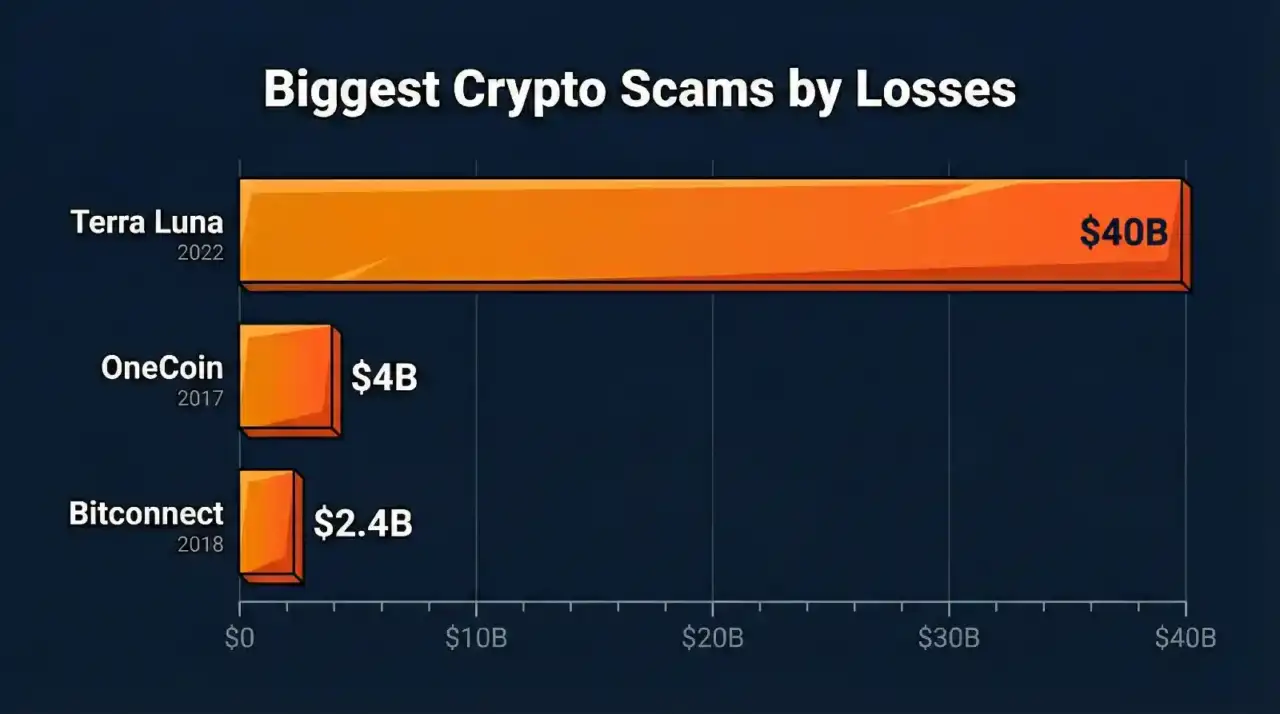
Understanding how major scams operated helps you recognize the patterns that repeat across fraudulent projects.
OneCoin ($4 Billion)
Launched in 2014, OneCoin operated for approximately three years before its leader, Ruja Ignatova (known as the “Cryptoqueen”) disappeared in October 2017. Authorities eventually recognized it as a massive Ponzi scheme with no actual blockchain technology. Ignatova remains on the FBI’s Ten Most Wanted Fugitives list, with a $5 million reward for information leading to her arrest.
OneCoin is widely considered the largest crypto scam in history, defrauding investors of an estimated $4 billion worldwide.
Bitconnect ($2.4 Billion)
Bitconnect operated as a lending platform promising returns of up to 40% per month through a supposed “trading bot.” In reality, it was a classic Ponzi scheme using new investor funds to pay earlier participants.
The SEC charged the company in 2021 with defrauding investors of $2 billion. In 2022, the U.S. Department of Justice indicted Bitconnect’s founder Satish Kumbhani for orchestrating a $2.4 billion global fraud scheme.
Terra Luna ($40 Billion Collapse)
In May 2022, the Terra ecosystem collapsed virtually overnight, wiping out approximately $40 billion in market value. The algorithmic stablecoin UST lost its peg, triggering a death spiral that rendered both UST and LUNA nearly worthless.
In 2023, the SEC charged Terraform Labs and founder Do Kwon with fraud. Kwon was arrested in Montenegro and faces extradition. In April 2024, a jury found Terraform Labs liable for defrauding investors.
Smaller Scams Continue Daily
While these headline-grabbing cases involve billions, smaller scams operate constantly. Rug pulls, fake token launches, and phishing schemes drain millions from unsuspecting users every month. The tactics have grown increasingly sophisticated, making it harder for average participants to distinguish legitimate projects from fraudulent ones.
7 Red Flags to Help You Avoid Crypto Scams
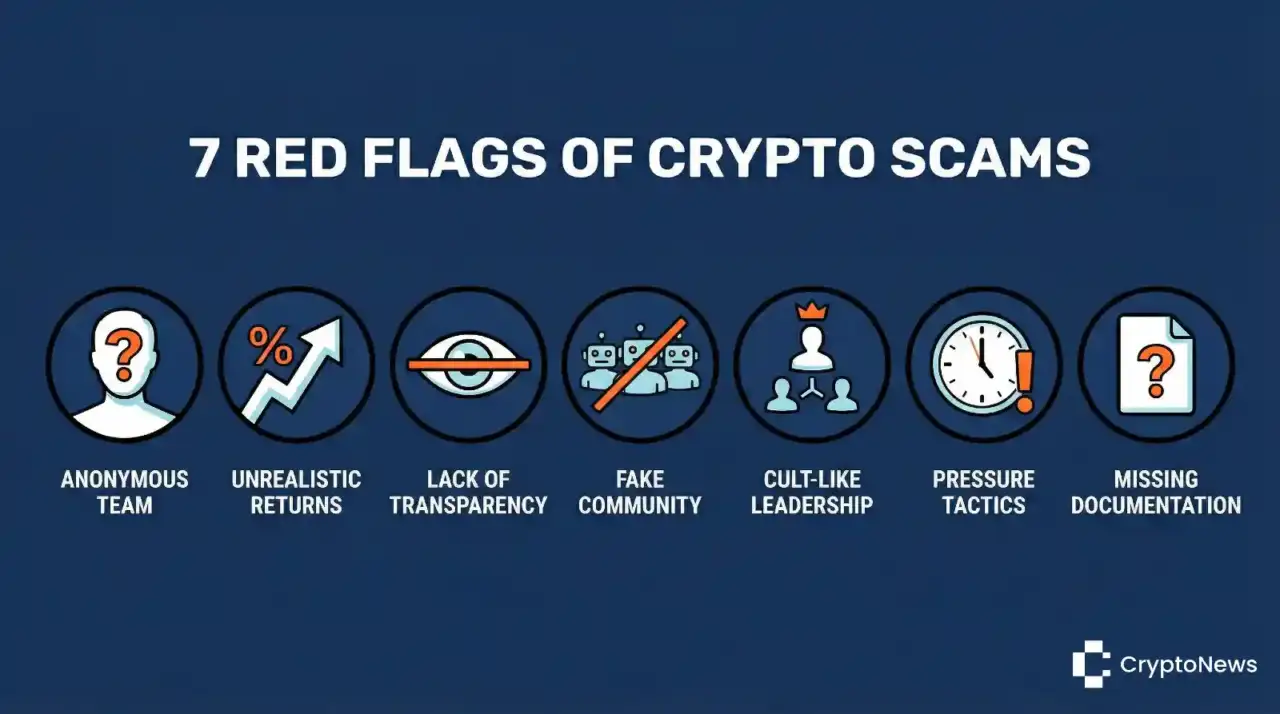
Knowing these seven red flags will help you avoid crypto scams before you invest. Here’s how to identify potentially fraudulent projects before investing:
1. Anonymous or Unverifiable Teams
The crypto space has a strong privacy culture rooted in cypherpunk principles. However, when a team is completely anonymous and asks for your money, the risk increases dramatically.
What to look for:
- No verifiable identities of founders or core team members
- LinkedIn profiles that don’t exist or were recently created
- No track record of previous projects
- Team photos that reverse-image search to stock photos
The nuance: Some legitimate projects have pseudonymous founders (Bitcoin’s Satoshi Nakamoto being the obvious example). The key difference is whether the project’s code is open-source and verifiable. Anonymous teams running closed-source projects with no audits should be treated with extreme caution.
2. Unrealistic Return Promises
If a project promises guaranteed returns, extraordinarily high yields, or “risk-free” profits, run.
Common red flags:
- “Guaranteed 10% daily returns”
- “Double your Bitcoin in 30 days”
- “Risk-free staking rewards of 1,000% APY”
- Vague explanations of how returns are generated
No legitimate investment can guarantee returns. In DeFi, high yields typically come from high risk; there’s no free lunch. When returns seem too good to be true, they’re usually funded by new investor deposits (a Ponzi structure) rather than actual value creation.
3. Lack of Transparency
Legitimate blockchain projects embrace transparency, as it’s one of the core value propositions of the technology. Projects that operate in secrecy are often hiding something.
Warning signs:
- No public smart contract addresses
- Unaudited or unverifiable code
- Vague or missing whitepaper
- No clear explanation of tokenomics
- Unwillingness to answer technical questions
What legitimate projects do: Open-source their code, publish audit reports from reputable firms (CertiK, Trail of Bits, OpenZeppelin), maintain public documentation, and engage openly with technical criticism.
4. No Real Community
Web3 is fundamentally about community. Legitimate projects cultivate engaged communities on Discord, Telegram, Twitter, and other platforms where members can interact with each other and the team.
Red flags:
- No community channels, or ghost-town activity levels
- Community discussion is discouraged or censored
- Bot-inflated follower counts (sudden spikes, generic comments)
- No response to legitimate questions or concerns
Healthy signs: Active discussion (including criticism), regular team updates, transparent governance processes, and community members who can speak to their experience with the project over time.
5. Cult-Like Leadership
Most major crypto scams have been led by charismatic individuals who cultivated devoted followings. OneCoin’s Ruja Ignatova held massive rallies. Bitconnect’s promoters became infamous for hyperbolic presentations.
Warning signs:
- Single leader dominates all communication
- Criticism of the leader is treated as attacks on the project itself
- Emotional manipulation (“You’re either with us or against us”)
- Claims of special knowledge or abilities
- Lavish lifestyle displays funded by investor money
Decentralized projects should have distributed leadership. If one person holds all the power and demands unquestioning loyalty, you’re looking at a centralized operation with the downsides of both worlds.
6. Pressure Tactics and Artificial Urgency
Scammers don’t want you to think carefully; they want you to act fast before you realize something’s wrong.
Common pressure tactics:
- “Limited time only, price increases tomorrow!”
- “Only 100 spots left at this tier!”
- “If you don’t invest now, you’ll miss the biggest opportunity of your life”
- Countdown timers and artificial scarcity
- Penalizing or shaming those who express hesitation
Legitimate projects don’t need high-pressure sales tactics. Good opportunities don’t disappear because you took a week to do proper due diligence.
7. Poor or Absent Legal/Technical Documentation
Legitimate projects provide clear information about their legal structure, jurisdiction, team, tokenomics, and technical architecture.
Red flags:
- No terms of service or privacy policy
- No information about the legal entity behind the project
- KYC required from users but no transparency about who’s running the project
- Whitepaper is vague marketing copy rather than technical documentation
- No security audits
If a project demands your personal information and money while providing none of their own verifiable details, the relationship is dangerously one-sided.
How to Avoid Crypto Scams: Due Diligence Checklist
This checklist will help you avoid crypto scams by verifying projects systematically. Before investing in any crypto project, work through this checklist:
Step 1: Verify the Team
- Search team members on LinkedIn, Twitter, GitHub
- Look for previous project involvement and track record
- Reverse-image search profile photos
- Check if credentials (degrees, past employers) are verifiable
Step 2: Examine the Code and Audits
- Is the smart contract code open-source?
- Has it been audited by a reputable firm?
- Read the audit report: what issues were found and were they fixed?
- Check DeFiSafety or similar platforms for security scores
Step 3: Analyze Tokenomics
- What percentage of tokens does the team hold?
- Is there a vesting schedule, or can insiders dump immediately?
- Is the token supply fixed or inflationary?
- What’s the unlock schedule for early investors?
Step 4: Assess Community Health
- Join the Discord/Telegram: is discussion genuine or bot-driven?
- Are critical questions answered or deleted?
- What do long-term community members say?
- Search Twitter and Reddit for organic discussion (not just promotional content)
Step 5: Check for Red Flags
- Run the token contract through TokenSniffer or RugDoc
- Search “[Project Name] + scam” or “+ rug” to see if others have raised concerns
- Check if the project has been flagged on CryptoScamDB
Step 6: Start Small
Even after thorough research, limit your initial investment to an amount you can afford to lose entirely. Increase exposure only after the project has demonstrated legitimacy over time.
What to Do If You’ve Been Scammed
If you’ve fallen victim to a crypto scam:
- Document everything: Save all transaction records, communications, wallet addresses, and screenshots.
- Report the scam:
- FBI Internet Crime Complaint Center (IC3)
- FTC Report Fraud
- Your local law enforcement
- The platform where the scam occurred (exchange, social media)
- Contact your exchange: If you sent funds from a centralized exchange, report the fraud immediately. Some exchanges can freeze destination addresses.
- Be wary of “recovery services”: Many services claiming to recover stolen crypto are themselves scams targeting victims a second time. Legitimate recovery is extremely difficult and rarely successful.
- Learn and share: Your experience can help others avoid the same trap. Consider sharing your story (without compromising ongoing investigations) to warn others.
The Bottom Line
Blockchain technology is built on transparency, accessibility, and trustlessness: the code itself provides the guarantees, not promises from individuals. When a project contradicts these principles by operating in secrecy, demanding blind trust, or making impossible promises, it has abandoned the core values that make crypto valuable in the first place.
The best way to avoid crypto scams is through knowledge and patience. Take the time to verify claims, examine code, and assess communities before committing funds. The legitimate opportunities in this space aren’t going anywhere, but your money will if you don’t exercise caution.
Stay vigilant, do your research, and you’ll be equipped to avoid crypto scams in any market condition.
Sources
- Federal Bureau of Investigation. (2024). 2023 Cryptocurrency Fraud Report. ic3.gov
- FBI. (2022). Ten Most Wanted Fugitives: Ruja Ignatova. fbi.gov
- U.S. Securities and Exchange Commission. (2021). SEC Charges Global Crypto Lending Platform and Top Executives in $2 Billion Fraud. sec.gov
- U.S. Department of Justice. (2022). Bitconnect Founder Indicted in Global $2.4 Billion Cryptocurrency Scheme. justice.gov
- U.S. Securities and Exchange Commission. (2023). SEC Charges Terraform and Do Kwon with Defrauding Investors. sec.gov
- Chainalysis. (2024). The 2024 Crypto Crime Report. chainalysis.com
Update History
December 8, 2025: Complete rewrite for YMYL compliance. Added citations, disclaimers, and sources section. Updated Terra Luna case with 2024 verdict. Removed promotional content.
H
